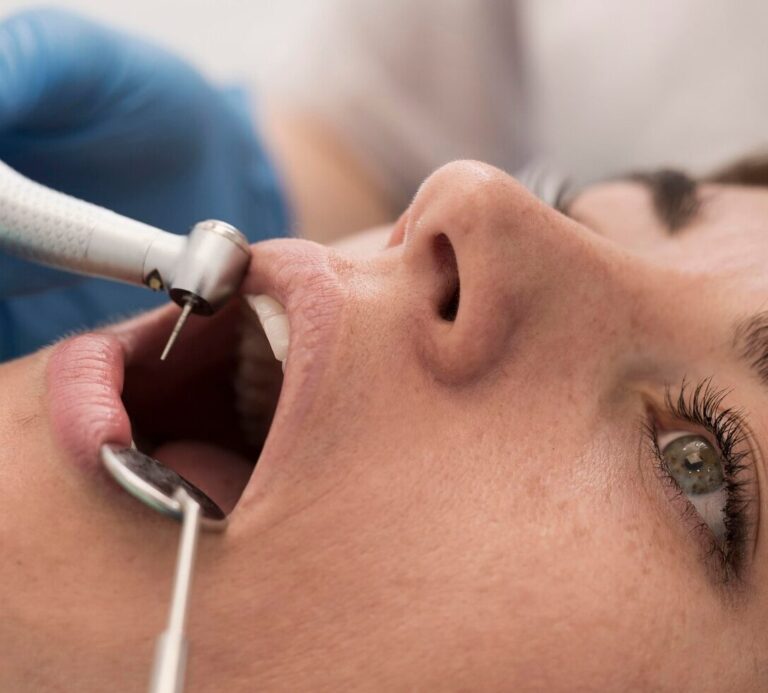
If your hygienist has measured your gums and recommended a deep cleaning, you probably left with questions. What actually happens? Does it hurt? What does it cost, and why won’t a regular cleaning do? A deep cleaning, also called scaling and root planing, is the standard non-surgical treatment for gum disease, and knowing what to expect makes the appointment much easier to walk into.
At Sol Dental Studio in Oakville, we would rather you understand the numbers before treatment starts. This guide explains what deep cleaning teeth involves, why it is recommended, how the appointment works, what it typically costs in Ontario (including insurance and the Canadian Dental Care Plan), which side effects are worth knowing about, and how recovery goes.
What is a deep cleaning?
A deep cleaning is a non-surgical gum treatment that cleans the root surfaces of your teeth below the gumline, inside the pockets that form when gum disease takes hold. The hardened deposits that brushing and a routine cleaning cannot reach are removed, and then the roots are smoothed so the gums can heal snugly against them.
You may also hear it called scaling and root planing, SRP, periodontal scaling, a periodontal cleaning, or a gum cleaning. They all describe the same two-part treatment:
- Scaling removes plaque and tartar (also called calculus) from the tooth and root surfaces, all the way to the bottom of each pocket.
- Root planing smooths the root surfaces once they are clean, so the gum can reattach and bacteria have fewer rough spots to cling to.
What is dental scaling?
Dental scaling is the removal of tartar with instruments. Tartar is plaque that has hardened onto the tooth, and no amount of brushing will shift it. Clinicians usually combine an ultrasonic scaler, which vibrates deposits loose under a fine spray of water, with hand instruments for the finer work. A routine cleaning scales above and just below the gumline, while a deep cleaning goes down into the pockets along the roots.
What is root planing?
Root planing is the smoothing step. Once the deposits are gone, the root surface is worked over until it is clean and smooth, which gives the gum a good chance to tighten back around the tooth and makes it harder for new plaque to settle into the pocket.
Root planing vs scaling
Scaling takes the deposits off, and root planing smooths the surface left behind. The two are done together, in the same appointment, which is why they are almost always described as one treatment. In Ontario, both are usually billed in units of time, and one unit is 15 minutes of treatment.
Why your dentist recommends a deep cleaning
Healthy gums fit snugly around each tooth, with a shallow space of about three millimetres or less between the gum and the tooth. When plaque and tartar sit at the gumline for long enough, the gum becomes inflamed and starts to pull away, and that space deepens into a pocket. Once a pocket is deeper than about three millimetres, neither your toothbrush nor a routine cleaning can reach the bottom of it.
Inside the pocket, bacteria sit on the root surface, and the body responds by slowly losing the bone that holds the tooth in place. A deep cleaning is usually recommended when:
- Pocket depths measure deeper than about 4 mm
- Your gums bleed regularly when you brush or floss
- There is persistent bad breath or a bad taste in your mouth
- Your gums have receded, or your teeth feel slightly loose
- X-rays show tartar below the gumline or the beginning of bone loss
Gum disease rarely hurts until it is advanced, which is why it is diagnosed by measurement rather than by how your mouth feels. In the earliest stage, gingivitis, only the gums are inflamed, and a routine cleaning plus better home care can reverse it. Once pockets have formed and bone has been lost, it is called periodontitis, and a deep cleaning is the treatment that stops it. The inflammation settles once the cause is removed, but lost bone does not grow back, which is why treating early matters.
How a deep cleaning differs from a routine cleaning
A routine cleaning looks after gums that are already healthy. It removes tartar at and just below the gumline, polishes the teeth, and is usually done with your checkup every six months. Our teeth cleaning page walks through a routine visit step by step.
A deep cleaning treats disease that has already moved below the gumline. It reaches into the pockets, cleans and smooths the roots, is done with the area frozen, and usually takes one or two visits. Its goal is to get your gums back to the point where routine cleanings are enough again.
The deep cleaning procedure, step by step
A deep cleaning is a short course of treatment rather than a single appointment. Most are finished in one or two visits, with one to two hours of chair time in total. At Sol Dental Studio, it follows the same steps every time:
- Measure and explain. Every tooth is measured at several points, and the pocket depths are recorded, along with any bleeding and recession. Together with your x-rays, those numbers show which areas are affected and how far the disease has gone, and we show them to you before anything starts.
- Freeze the area. Freezing (a local anesthetic) is standard for a deep cleaning, not an optional extra, so the treatment stays comfortable. It is also why the mouth is often treated one side at a time.
- Scale below the gumline. Tartar and plaque are removed from the root surfaces inside each pocket, one area at a time.
- Plane the roots. The cleaned root surfaces are smoothed so the gum can reattach.
- Re-measure after four to six weeks. We chart the pockets again. Shallower pockets and no bleeding mean the treatment worked, and any area that has not responded gets its own specific plan, rather than a repeat of the whole treatment.
- Move to maintenance. Most people then come in every three to four months while their gums stabilize, instead of every six.
Your dentist may also prescribe an antimicrobial mouth rinse to use at home while your gums heal. Because the cost is based on treatment time, your written estimate will reflect how much scaling your mouth is expected to need.

Does a deep cleaning hurt?
The treatment itself should not hurt, because the area is frozen first. Most people feel pressure, vibration, and a scraping sensation, but not pain. If you are nervous, tell us at the start. We work at a pace you set, and a deep cleaning is often split into shorter visits anyway.
Once the freezing wears off, it is normal for your gums to feel tender for a day or two, and for your teeth to be more sensitive to cold as the cleaned roots settle. If you need it, an over-the-counter pain reliever that you know is safe for you is usually enough for the first day. If swelling gets worse after a couple of days, or you develop a fever or pain that keeps building, call the clinic.
How much does a deep cleaning cost in Ontario?
In Ontario, most courses of deep cleaning land between roughly $200 and $600, and heavier cases treated over several visits cost more. The price follows the time involved. Scaling and root planing are charged in units of time, with one unit equal to 15 minutes, so a mouth with a few affected areas costs far less than one with deep pockets around most of the teeth. For comparison, a routine cleaning is typically quoted at about $120 to $300 per visit.
These are typical ranges, not quotes. Your own figure depends on how many teeth need treatment and how much scaling time they need, and you should see it in writing before any treatment begins.
Deep cleaning cost with insurance
Gum treatment is generally well covered by dental insurance, because it is medically necessary rather than cosmetic. Plans differ in the percentage they pay and in how many units of scaling they cover each year, so check your limits before a longer course of treatment. We help you understand your coverage and submit the claims, so you know your real out-of-pocket cost.
Deep cleaning teeth cost without insurance
Without insurance, you pay the clinic’s fee for the scaling and root planing time your mouth needs, plus the exam, x-rays, and gum charting if those are not already up to date. Ask for a written estimate first, and ask how the treatment will be split across visits, so you can plan for each one.
Does the CDCP cover deep cleaning?
Yes, for eligible patients. The Canadian Dental Care Plan (CDCP) lists scaling and root planing among its periodontal services. As of 2026, for patients aged 17 and over, it covers up to 4 units of scaling and root planing combined in any 12 months without preauthorization. For any additional units, your provider has to request preauthorization, supported by your periodontal charting, x-rays, and clinical notes. Sol Dental Studio accepts the CDCP for eligible patients.
Your share of the cost depends on your adjusted family net income:
| Adjusted family net income | CDCP pays (of its set fees) | Your co-payment |
|---|---|---|
| Under $70,000 | 100% | 0% |
| $70,000 to $79,999 | 60% | 40% |
| $80,000 to $89,999 | 40% | 60% |
The CDCP’s fees are not always the same as what a clinic charges, so there can be an additional amount to pay, even with a 0% co-payment. The government recommends asking your provider about any costs the plan will not cover before you receive treatment, and its CDCP coverage page explains the rules in full. For how it works at our clinic, see our CDCP page.
Benefits of deep cleaning teeth
Followed by good home care and regular maintenance, a deep cleaning:
- Stops the disease from progressing, by removing the tartar and bacteria that drive the gum and bone loss.
- Lets pockets shrink. As the inflammation settles, the gum can tighten and reattach to the clean root.
- Reduces bleeding and bad breath, because healthier gums bleed less and the bacteria below the gumline are gone.
- Protects your teeth. Stopping bone loss early gives your teeth a far better chance of staying firm.
- Costs less than waiting. Left untreated, gum disease can end in extractions and replacements, which cost far more.
Deep cleaning teeth before and after
Before treatment, gums with active disease tend to look red or purplish, feel puffy, and bleed easily, often with tartar visible at the gumline. After a successful deep cleaning, gums usually look pinker and firmer, bleed far less, and fit more closely around the teeth. The most important change is one you cannot see: when the treatment has worked, the pockets measure shallower at the re-check.
Disadvantages and side effects of deep cleaning teeth
A deep cleaning is a routine, low-risk treatment, but it does have downsides, and it is better to know them before you start:
- Tenderness. Gums are usually sore for a day or two after each visit.
- Sensitivity. Freshly cleaned roots can be sensitive to cold, and sometimes heat, for a few weeks, occasionally a month or two. A toothpaste for sensitive teeth helps in the meantime.
- Some bleeding. A little bleeding when you brush in the first few days is normal.
- More visible gaps. As swollen gums shrink back, spaces between the teeth can become more noticeable, and teeth can look slightly longer.
- Time and cost. Treatment usually means one or two visits, a re-check, and more frequent maintenance visits afterwards.
- A small risk of infection for some people. Cleaning below the gumline can release bacteria into the bloodstream. For most people, this is harmless, but if you have certain heart conditions, a joint replacement, or a weakened immune system, tell us before treatment, because your dentist may recommend antibiotics or check with your physician first.
Why you may notice gaps in your teeth after a deep cleaning
This is the side effect that surprises people most. When gums are inflamed, they swell and fill the spaces between the teeth. After a deep cleaning, the swelling goes down and the gums tighten, so small gaps near the gumline, sometimes called black triangles, can suddenly become visible.
The deep cleaning did not create those spaces. They show gum and bone support that the disease had already taken away, which the swelling was hiding. If a gap still bothers you once your gums have settled, ask about ways to disguise it, such as tooth-coloured bonding, which is part of our cosmetic dentistry.
What to eat after a deep cleaning
Wait until the freezing has worn off before you eat, so you do not bite your cheek or tongue without noticing. After that, you can eat normally as long as it is comfortable, although most people find soft, lukewarm foods easier for the first day or two.
| Easier for the first day or two | Better to skip until your gums settle |
|---|---|
| Yogurt, smoothies, and applesauce | Chips, crackers, and crusty bread |
| Eggs, soft pasta, and rice | Nuts, seeds, and popcorn |
| Mashed potatoes and cooked vegetables | Very spicy or acidic foods |
| Soup that has cooled a little | Very hot or ice-cold drinks |
Popcorn hulls and small seeds are worth avoiding for a few days, because they can lodge in tender gums.
Deep cleaning recovery timeline and aftercare
Recovery from a deep cleaning is quick, but what you do in the weeks afterwards decides how well it works:
| When | What to expect |
|---|---|
| The first few hours | The freezing wears off. Eat once it has, and expect some tenderness. |
| Days 1 to 3 | Gums feel tender and may bleed a little when you brush. Warm salt-water rinses help. |
| The first few weeks | Sensitivity to cold fades gradually, and gums look pinker and bleed less. |
| Weeks 4 to 6 | A re-check appointment, where the pockets are measured again to confirm your gums responded. |
| Every 3 to 4 months | Maintenance visits while your pockets stabilize. |
To help your gums heal:
- Rinse with warm salt water for the first few days.
- Keep brushing gently with a soft-bristled toothbrush. Bleeding gums still need cleaning, and skipping them only slows healing.
- Clean between your teeth every day. Once there has been some recession, interdental brushes usually work better than floss.
- Use any mouth rinse your dentist prescribes, exactly as directed.
- If you smoke, know that smoking is the single biggest factor working against the treatment. We can point you to support if you want to quit.
How to prevent needing another deep cleaning
After a deep cleaning, the goal is never to need another one:
- Keep your maintenance visits. A three-to-four-month interval removes new tartar before it can work its way back below the gumline. Once your pockets are stable, your dentist may lengthen the interval again.
- Brush twice a day for two minutes, angling the bristles into the gumline. Our guide to brushing and flossing techniques shows how.
- Clean between your teeth once a day, with floss, interdental brushes, or a water flosser, whichever you will actually use.
- Manage the risk factors you can. Smoking and poorly controlled diabetes both make gum disease harder to keep under control.
Once your gums are healthy again, routine cleanings take over. Our article on how often you should have your teeth cleaned explains how the right interval is set.
Deep cleaning at Sol Dental Studio in Oakville
If you have been told you need a deep cleaning, or your gums bleed and you would like them checked, our deep teeth cleaning treatment starts with measurement. We chart every pocket, show you the numbers and your x-rays, and give you the cost in writing before any treatment begins. The area is always frozen, treatment is usually split by side, and we re-measure four to six weeks later, so you can see whether it worked.
We accept the CDCP for eligible patients, help with insurance claims, and offer care in English, Mandarin, Portuguese, Punjabi, Hindi, and Urdu. You can read about Dr. Richard He before your first visit. To book, call (289) 644-1701 or contact us online. We are at 2450 Old Bronte Rd, Unit E, in Palermo Village at Dundas and Old Bronte, and new patients are welcome.
Frequently asked questions
How long does a deep cleaning take?
Most deep cleanings take one or two visits and one to two hours of chair time in total. A mouth with many affected areas may need more time, which is why treatment is often split by side.
Is a deep cleaning really necessary?
If your pockets measure deeper than about 4 mm and your gums bleed, yes. A routine cleaning cannot reach the bottom of those pockets, so the tartar below the gumline would stay in place, and the bone loss would continue.
Can I get a regular cleaning instead of a deep cleaning?
You can decline any treatment, but a regular cleaning will not treat active gum disease, because it does not reach the deposits on the roots. If cost or timing is the concern, ask about splitting treatment across visits and checking your coverage first.
How often do you need a deep cleaning?
Ideally, once. Afterwards, most people move to maintenance visits every three to four months. A second deep cleaning is only needed if pockets deepen again, which regular maintenance and good home care help prevent.
Is a deep cleaning covered by insurance?
Gum treatment is generally well covered by dental insurance, because it is medically necessary. Plans differ in how many units of scaling they allow each year. As of 2026, for eligible patients aged 17 and over, the CDCP covers up to 4 units of scaling and root planing in any 12 months without preauthorization.
Why do my teeth feel strange after a deep cleaning?
Your teeth may feel smoother, more sensitive to cold, and slightly different where the gums have tightened. Deposits that may have been there for years are gone, and the feeling usually passes within a few weeks.
Can a deep cleaning damage your teeth?
A deep cleaning is designed to remove hardened deposits and smooth the roots, not to remove healthy tooth structure. The most common after-effects are temporary tenderness and sensitivity, and untreated gum disease does far more damage than the treatment.
Do gums grow back after a deep cleaning?
Swollen gums shrink and tighten as they heal, and they can reattach to the clean root, which is why pockets can become shallower. Gum and bone that were lost to the disease do not grow back on their own.
Can gum disease be reversed?
Gingivitis, the early stage, can be reversed with a professional cleaning and good home care. Periodontitis can be controlled with a deep cleaning and regular maintenance, but lost bone does not grow back.