In addition to affecting your smile, losing one or more teeth can have an impact on your self-esteem, how you feel, how you speak, and how you eat. Modern advances in tooth replacement options leave you with more options than ever. Today’s leading tooth replacement solutions are dental implants and dental bridges. Knowing which option to choose can be difficult. At Sol Dental Studio, we help our clients with this important choice. To help you understand the important features to consider, we have outlined the differences.
Why Replacing a Missing Tooth Matters
It might be tempting to leave a gap alone, especially if it’s not visible when you smile. But missing teeth can cause real problems over time:
- Neighboring teeth can shift into the space
- Your bite and jaw alignment can change
- Chewing and speaking can become more difficult
- The jawbone beneath the gap can begin to shrink
Replacing a missing tooth protects your oral health, your appearance, and your long-term comfort — which is exactly why choosing the right solution matters.
What Is a Dental Bridge?
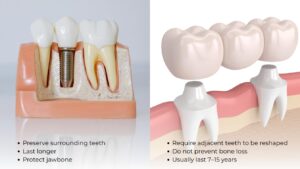
Dental bridges are designed to fill the gaps where one or more teeth are missing. A pontic (an artificial tooth) is secured to adjacent natural teeth by crowns.
Traditional, cantilever, and Maryland bridges are the main classifications. Deciding on the most appropriate type of bridge depends on the missing tooth location as well as the condition of the surrounding teeth. Dental bridges are an easy, effective solution to missing teeth, taking as few as two office visits.
What Is a Dental Implant?
A dental implant replaces the entire tooth, including the root. It’s a small titanium post that’s surgically placed into the jawbone, where it fuses with the bone over time. Once healed, a custom crown is attached on top, creating a replacement tooth that looks, feels, and functions like a natural one.
Because implants replace the root, they’re the only option that helps preserve the jawbone and prevent the bone loss that comes with missing teeth.
What Is an Implant-Supported Bridge?
If you’re missing several consecutive teeth, an implant-supported bridge may be the ideal solution. Instead of anchoring the bridge to your natural teeth, it’s secured by two or more dental implants placed in the jaw.
This approach combines the strengths of both treatments: the stability and bone-preserving benefits of implants with the efficiency of a bridge to replace multiple teeth at once. An implant-supported bridge is often recommended when several adjacent teeth are missing, and you want a strong, long-lasting result without placing an individual implant for every tooth.
Dental Bridge vs. Implant: Key Differences
Here’s how the two compare at a glance:
| Feature | Dental Bridge | Dental Implant |
| Procedure | Non-surgical, 2+ visits | Minor surgery, multiple stages |
| Timeline | A few weeks | Several months (for healing) |
| Lifespan | Around 10–15 years | Can last a lifetime with care |
| Neighboring teeth | Adjacent teeth are reshaped | Untouched, stands alone |
| Bone health | Doesn’t prevent bone loss | Preserves the jawbone |
| Upfront cost | Lower | Higher |
In short, a bridge offers a faster, lower-cost fix, while an implant offers the most durable, bone-preserving result.
Pros and Cons of Dental Bridges
Pros:
- Faster treatment, usually completed in a few weeks
- Lower upfront cost
- No surgery required
- A great option when adjacent teeth already need crowns
Cons:
- Typically lasts 10–15 years before needing replacement
- Requires reshaping healthy neighboring teeth
- Doesn’t stop the bone loss beneath the gap
Pros and Cons of Dental Implants
Pros:
- The longest-lasting option — often a lifetime with proper care
- Preserves the jawbone and facial structure
- Stands on its own without affecting neighboring teeth
- Looks and feels the most natural
Cons:
- Higher upfront investment
- Requires minor surgery
- Takes longer overall, since the jaw needs time to heal

How Much Do Bridges and Implants Cost?
A dental bridge usually has a lower upfront cost, which makes it attractive if budget or timing is a concern. A dental implant costs more initially, but because it can last a lifetime and protects your bone health, it often delivers greater long-term value.
Many dental insurance plans contribute toward both treatments. At Sol Dental Studio, we’ll walk you through the full cost of each option, explain your coverage, and discuss flexible payment plans so you can choose with confidence.
How to Choose the Right Option for You
The best choice depends on your unique situation. We’ll consider:
- How many teeth are you missing, and where
- The health of your jawbone — some patients may need a bone graft for implants
- Your budget and timeline
- Your overall health and personal preferences
There’s no one-size-fits-all answer, which is why a consultation and imaging are so valuable. They let us recommend the option that fits your mouth, your goals, and your lifestyle.
Still Not Sure? Let’s Find Your Best Option
Both bridges and implants are excellent ways to restore your smile — the right one simply comes down to your mouth, your goals, and your budget. The team at Sol Dental Studio is here to answer your questions and help you make a confident, informed decision.
Book your tooth-replacement consultation with Sol Dental Studio today and take the first step toward a complete, healthy smile.
Frequently Asked Questions
1. Are implants better than bridges?
Implants tend to last longer and preserve bone, but bridges are faster and more affordable upfront. The “better” choice depends on your needs and budget.
2. Which lasts longer, a bridge or an implant?
Implants can last a lifetime with proper care, while bridges typically last 10–15 years before needing replacement.
3. Is a bridge or an implant cheaper?
A bridge usually has a lower upfront cost, but an implant can offer better long-term value thanks to its durability.
4. Does insurance cover bridges and implants?
Many plans contribute toward both. Our team can help you understand your specific coverage.
5. Can I switch from a bridge to an implant later?
In many cases, yes — though bone health is a factor. We can assess your options at any time.