Why Dental Implants Are the Gold Standard
Lost a tooth and unsure what to do next? Did you know you can have jawbone shrinkage, your teeth can shift, and even your face can change how it looks?
Teeth are more than just for looks! They help you eat and talk. They can also have an impact on your self-confidence. If you want a solution that looks natural and is permanent, you should consider getting dental implants.
In this guide, we are gonna talk about how dental implants even work. We are also gonna talk about the types of dental implants and the costs. We can also help you compare implants, dentures, and bridges. Finally, we will talk about the process and healing for implants.
What Are Dental Implants?
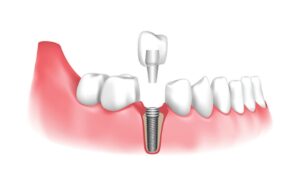
At the clinic, we use titanium posts to replace the roots of the missing teeth. After they heal, we provide a crown to the patient to complete the procedure.
Other than sad-looking gaps, a removable denture has the following downsides: they can be unstable, and can shift around and break, making dental implants for missing teeth the ideal alternative.
A lot of clients who choose to improve their smile with Invisalign and smile design beautification choose missing teeth dental implants as the final touch. Smile design and beautification are holistic procedures as they go from a smile with crooked teeth to a complete smile with no gaps.
How Dental Implants Work
When patients know what is involved in a dental procedure, they are more relaxed.
Your jawbone goes through a process called osseointegration with the titanium implant. This becomes the base for a crown, bridge, or full-arch restoration.
Because the implant fuses with bone, it:
- Functions like a natural tooth root
- Prevents bone loss
- Preserves facial structure
- Does not rely on neighboring teeth
This is why implants often outperform other solutions in dentures and bridges comparisons.
Types of Dental Implants
Endosteal Implants
The most common type is placed directly into the jawbone.
Subperiosteal Implants
Placed under the gum but above the jawbone, it is ideal for patients with limited bone.
Zygomatic Implants
Used in severe bone loss cases, anchored in the cheekbone.
Single Implants, Implant Bridges & Full-Arch (All-on-4)
- Replace one tooth
- Replace multiple teeth
- Replace a full set of teeth
Smile restoration can be improved with targeted implant placement for patients who have had previous orthodontic treatment, such as Invisalign.
Dental Implants Procedure
Step 1 – Consultation & Planning
3D scans and X-rays evaluate bone health and determine eligibility.
Step 2 – Implant Placement
The titanium post is surgically placed under local anesthesia or sedation.
Step 3 – Dental Implant Healing Process
Over 3–6 months, the implant fuses with your jawbone.
Step 4 – Crown Placement
A custom crown is attached, restoring full function.
The dental implant healing process is gradual but critical for long-term success.
Dental Implant Cost Breakdown
A typical dental implant cost breakdown includes:
- Implant post: $1,000–$3,000
- Abutment & crown: $1,000–$3,000
- Bone graft (if needed): $500–$3,000
- Full-arch restoration: $15,000–$30,000+
The total cost depends on complexity, materials, and location.
Many practices now offer financing options, making affordable dental implants more accessible. Compared to replacing dentures or bridges every few years, implants often provide better long-term value.
Dental Implants vs Dentures
When comparing dental implants vs dentures:
- Permanent and fixed
- Prevent bone loss
- Feel natural
- No slipping
- Removable
- May shift or click
- Do not prevent bone deterioration
Although dentures may cost less initially, implants provide greater comfort, stability, and long-term dental benefits.
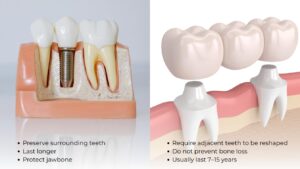
Dental Implants vs Bridges
In a dental implants vs bridges comparison:
Dental Implants
- Preserve surrounding teeth
- Last longer
- Protect jawbone
- Require adjacent teeth to be reshaped
- Do not prevent bone loss
- Usually lasts 7–15 years
Implants often provide superior durability and structural support.
Dental Implant Alternatives
Common dental implant alternatives include:
- Partial dentures
- Full dentures
- Dental bridges
- Resin-bonded bridges
Your dentist will recommend the most suitable option based on your needs and bone health.
Dental Implants Benefits
The most important dental implants benefits include:
- Long-lasting durability
- Natural appearance
- Improved chewing and speech
- Prevention of bone loss
- Enhanced confidence
For patients investing in treatments like Invisalign, implants are often the final step in achieving a fully restored smile.
Dental Implants Recovery & How to Care for Dental Implants
Most patients experience mild swelling and discomfort for a few days.
Dental Implant Healing Process Timeline
- Week 1: Gum healing
- Months 3–6: Bone integration
- Final crown placement after full fusion
How to Care for Dental Implants
Knowing how to care for dental implants ensures long-term success:
- Brush and floss daily
- Maintain regular dental visits
- Avoid smoking
- Follow your dentist’s aftercare instructions
With proper care, implants can last 20+ years.
Conclusion: Restore Your Smile with Sol Dental
Looking into dental implants or dentures? Trying to figure out dental implants or dental bridges? Looking for cheap dental implants? The right info makes a difference, the right info makes a difference.
Our staff at Sol Dental have the best technology and the best info and the best info to make sure your smile is as confident as it can be. Missing teeth can take a toll on your health as well as your self-esteem. Don’t let it get to that point.
Contact Sol Dental for a dental implants consultation and get a confident smile starting today.
Frequently Asked Questions
1. What is the lifespan of dental implants?
Dental implants can last longer than 20 years and often for a lifetime if taken care of properly.
2. Are dental implants a painful procedure?
During the procedure, you will be put under anesthesia, and most patients say the recovery is not painful.
3. Are there low-cost dental implants?
Yes. There are many clinics that have payment plans and financing options.
4. What dental implant options have the best quality?
There are dentures and bridges, but they do not give the same long-term stability and do not help keep the bone as implants do.