Noticed a chalky white patch on a tooth that will not brush away? Or been told you have the very beginning of a cavity, and have been dreading the drill? There is a treatment for exactly that situation — and it involves no drilling, no needle, and usually a single visit.
Resin infiltration is one of the most conservative treatments in modern dentistry. At Sol Dental Studio in Oakville, we would always rather strengthen a tooth than cut into it, and this is a good example of that approach in practice. Here is what the treatment is, what it can and cannot fix, how the appointment goes, and what it is likely to cost.
What Is Resin Infiltration?
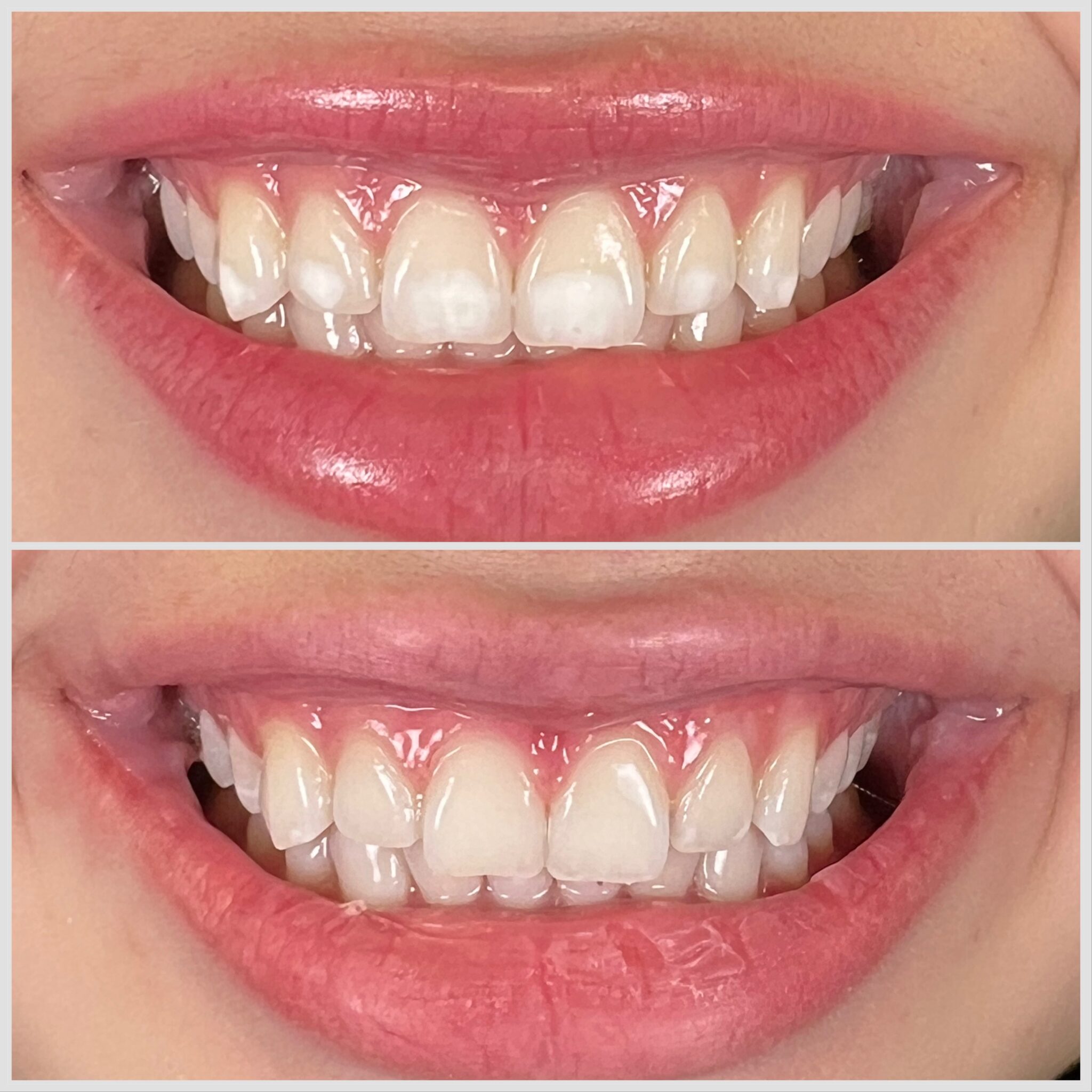
Resin infiltration is a minimally invasive treatment that repairs and camouflages weakened or discoloured enamel — without drilling, freezing, or removing any healthy tooth structure. Rather than cutting away the affected area as a traditional filling does, your dentist applies a very fluid, tooth-coloured resin that soaks into the microscopic pores inside the damaged enamel and is then hardened in place.
The technique is best known through the Icon system, which was developed specifically to treat white spot lesions and early enamel decay. Unlike veneers, which cover the front of a tooth, resin infiltration works inside the enamel — reinforcing it from within rather than hiding it behind something new.
How Does Resin Infiltration Work?
To understand the treatment, it helps to understand why white spots look white in the first place.
Healthy enamel is dense and translucent, so light passes through it and picks up the natural colour of the tooth underneath. When enamel loses minerals — the process called demineralisation — microscopic pores open up beneath the surface. Those pores are filled with air and water, which bend light very differently from solid enamel. The area scatters light instead of transmitting it, and your eye reads that as a chalky white or dull patch.
Resin infiltration works by replacing what is in those pores. The resin has a refractive index close to that of natural enamel, so once it has soaked in and been cured, light travels through the area much as it does through healthy enamel. The white spot blends into the surrounding tooth, and because the pores are now sealed, early decay is stopped from progressing deeper.
That dual effect is what makes the treatment unusual: it is cosmetic and preventive at the same time.
What Resin Infiltration Is Used For
- White spot lesions — the most common reason patients ask about it, often appearing after braces or clear aligner treatment where plaque sat around brackets or along the gum line.
- Early-stage cavities — incipient decay that has demineralised the enamel but has not yet broken through into a cavity.
- Fluorosis — the mottled white or brownish flecking caused by excess fluoride exposure while teeth were developing.
- Developmental enamel defects — patchy, opaque areas present since the tooth first came in.
- General enamel dullness from demineralisation, where teeth look flat rather than glossy.
Who Is a Good Candidate — and Who Isn’t
Being honest about the limits matters here. Resin infiltration works best on shallow, surface-level problems in enamel. Ideal candidates have mild to moderate white spots or very early decay, and reasonable oral hygiene.
It is not the right treatment if the decay has already formed a hole, if the discolouration comes from deep within the tooth — such as staining after trauma or from certain medications — or if a large amount of tooth structure is already missing. In those cases, a filling or other restorative treatment is the appropriate route, and pretending otherwise would only delay the care you need.
It is also worth knowing that results vary with how deep the lesion runs. Shallow spots often disappear almost entirely; deeper ones improve markedly but may remain faintly visible. We will tell you which category yours falls into before you decide.
Benefits of Resin Infiltration
- No drilling and no needle. Anaesthetic is generally unnecessary because nothing is being cut.
- Nothing healthy is removed. Once tooth structure is gone, it is gone for good — this treatment keeps all of it.
- Better appearance. White spots blend into the natural tooth rather than being covered over.
- Early decay is halted. Sealing the pores stops the lesion from progressing, so a future filling may be avoided altogether.
- One visit. Most cases are finished in a single appointment, often under an hour.
- Comfortable. Most patients report little or no discomfort during or after treatment.
- No downtime. You can eat and drink normally straight away.
The Resin Infiltration Procedure, Step by Step
- Assessment. We examine the tooth, take any images needed, and confirm the discolouration is the kind that responds to infiltration.
- Cleaning and isolation. The tooth is cleaned and kept dry, usually with a protective barrier so the etching gel stays exactly where it should.
- Etching. A gentle etch is applied for a short time to open the surface layer and expose the pores underneath.
- Drying. The area is thoroughly dried so the resin can travel into the pores rather than being blocked by moisture.
- Infiltration. The low-viscosity resin is applied and given time to soak in. This step may be repeated to make sure the pores are fully filled.
- Curing. A curing light hardens the resin in place.
- Polishing. The surface is smoothed and polished to a natural finish, and we check the colour match in normal light.
The whole appointment typically takes under an hour for one or two teeth, and there is no recovery period — you can head straight back to your day.
Resin Infiltration vs Other Treatments
| Treatment | Drilling required | Best for |
|---|---|---|
| Resin infiltration | No | White spots and early enamel decay |
| Dental filling | Yes | Established cavities with lost structure |
| Teeth whitening | No | Overall shade and surface staining |
| Veneers | Minimal to yes | Major changes to shape, size, or colour |
Resin infiltration fills a genuine gap between these options. Whitening will not remove a white spot — in fact it often makes the contrast temporarily more obvious, because the spot lightens faster than the surrounding enamel. A filling means cutting into a tooth that has not yet developed a cavity. Veneers are a far larger commitment for what may be a small blemish. Where a case suits it, infiltration is the least destructive way to get a good result, and it is often used before whitening so the two work together rather than against each other.
Aftercare and How Long Results Last
Aftercare is genuinely simple: there are no restrictions, and you can eat and drink as normal immediately. To keep the result looking its best:
- Brush twice a day and floss daily, paying attention to the gum line where white spots most often start
- Go easy on strongly staining foods and drinks — coffee, red wine, dark berries, curry — and rinse with water afterwards
- Keep up regular checkups and professional cleanings so any new demineralisation is caught early
- Cut back on frequent snacking and sipping sugary or acidic drinks, which is what drives demineralisation in the first place
The resin becomes part of the enamel structure and does not wash out, so results are stable rather than something that fades in a few months. With good hygiene, most patients keep the improvement for years. What can change the appearance over time is the surrounding tooth staining or new demineralisation developing elsewhere — which is why the habits above matter.
How Much Does Resin Infiltration Cost?
Cost depends on how many teeth are treated and how complex the case is. Because it is a single-visit treatment with no laboratory work involved, resin infiltration is generally more affordable than the alternatives it replaces — a filling and eventual crown on one hand, or veneers on the other — and treating several teeth in one appointment brings the per-tooth cost down.
On insurance, be prepared for a mixed answer. Because the treatment sits between cosmetic and preventive care, some plans contribute and others classify it as cosmetic and decline. We will check your specific plan and give you the numbers in writing before anything is booked, so there are no surprises. If you do not have private coverage, our page on the Canadian Dental Care Plan explains what the federal plan does and does not include. We also offer flexible payment options — just ask.
Preventing White Spots in the First Place
Resin infiltration fixes the appearance, but it is worth understanding what caused the spot so you do not collect more:
- Keep plaque off the gum line. White spots form where plaque sits undisturbed — around orthodontic brackets, along the gum margin, and between crowded teeth.
- Use fluoride properly. Fluoride helps enamel take minerals back up, which can reverse the earliest stages before infiltration is even needed.
- Reduce acid frequency, not just quantity. Sipping one soft drink across an afternoon is harder on enamel than drinking it in five minutes.
- Be extra diligent during orthodontic treatment, when brackets and attachments make cleaning harder.
- Bring children in early. Our children’s dentistry visits are where developing enamel problems get spotted while they are still easy to manage.
Ready to Treat Those White Spots?
If white spots or early decay are stopping you from feeling good about your smile, resin infiltration may be exactly the gentle, effective solution you have been looking for — and if it is not the right fit, we will tell you that too. Book a consultation with Sol Dental Studio in Oakville and we will assess your teeth and walk you through the options. Call (289) 644-1701 or see our new patient information to get started, and you can read more about Dr. Richard He before your visit.
Frequently Asked Questions
1. Does resin infiltration hurt?
No. There is no drilling and no tooth structure removed, so anaesthetic is generally not needed. Most patients feel nothing beyond the mild taste of the etching gel and the pressure of the barrier keeping the tooth dry.
2. How long does resin infiltration last?
The resin becomes part of the enamel and does not wash away, so results are long-lasting and typically hold for years with good oral hygiene and regular cleanings.
3. Can resin infiltration remove all white spots?
It significantly improves the appearance of most white spots, and shallow ones often become almost invisible. Deeper lesions improve noticeably but can remain faintly visible, so we will give you a realistic expectation beforehand.
4. Is resin infiltration better than a filling?
For white spots and very early decay, yes — it preserves your natural tooth instead of cutting into it. Once decay has formed an actual cavity, a filling is still the correct treatment.
5. How much does resin infiltration cost?
It depends on how many teeth are treated. It is usually less expensive than fillings or veneers for the same teeth, and treating several at once lowers the per-tooth cost. We provide a written estimate at your consultation.
6. Will insurance cover resin infiltration?
It varies by plan. Some insurers contribute because the treatment prevents decay from progressing; others classify it as cosmetic and do not. We will verify your coverage before treatment so you know your out-of-pocket cost in advance.
7. Can I have whitening and resin infiltration together?
Often, yes — and the order matters. Whitening alone can make a white spot look more obvious, so we usually plan any whitening first and then infiltrate, or discuss the best sequence for your particular teeth.
8. Can resin infiltration be done on children’s teeth?
Yes. Because it requires no drilling or freezing, it can be a good option for children and teenagers with white spots or fluorosis, provided they can sit comfortably for the appointment.
9. What if resin infiltration does not work for my teeth?
If the result is not what you hoped for, nothing has been lost — no tooth structure was removed, so every other option remains open, including whitening, bonding, or veneers.