If you’re missing a tooth — or several — you’ve probably started looking into dental implants and quickly run into one big question: what will it cost? The honest answer is that the cost of dental implants in Ontario is different for every patient. Two people can walk into the same Oakville clinic and leave with very different quotes, and both can be completely fair.
That’s not a dodge. It’s just how implant treatment works. The price reflects your specific mouth, the type of tooth replacement you need, and the care that goes into doing it well. In this guide, our team at Sol Dental Studio in Oakville breaks down exactly what affects the price, so you can read your own estimate with confidence and know which questions to ask.
A Quick Look at What a Dental Implant Actually Is
A dental implant is a small titanium post that a dentist places into your jawbone to replace the root of a missing tooth. Over a few months, the bone heals around it and holds it firmly in place. On top of that post sits an abutment (a connector) and then your final tooth — usually a crown, bridge, or denture.
So when you pay for “an implant,” you’re really paying for three parts plus the skill to place them: the post, the connector, and the visible tooth. Understanding these pieces makes it much easier to see why quotes vary. The Cleveland Clinic has a helpful plain-language overview of how the parts work together if you want to go deeper.
Typical Dental Implant Costs in Ontario
Every clinic quotes differently, and the only number that truly matters is the one on your own written estimate. That said, it helps to know the ballpark Ontario patients commonly see:
| Treatment | What Ontario Patients Are Commonly Quoted |
|---|---|
| Single implant (post + abutment + crown) | About $3,000 – $5,000 all-in |
| Bone graft (only if needed) | A few hundred to a few thousand dollars, depending on extent |
| Implant-supported bridge (several teeth) | More than a single implant, but less than one implant per tooth — quoted per case |
| Full-arch / full-mouth implants | The largest investment; always quoted after an exam and 3D imaging |
Treat these as orientation, not a menu. The only accurate price follows an exam, because your bone, gums, and bite decide what your treatment actually involves.
What Affects the Cost of Dental Implants in Ontario
Here are the main factors that shape your final price.
How Many Implants You Need
Replacing one tooth costs far less than rebuilding a full arch. A single implant is the simplest case. If you’re missing several teeth in a row, your dentist may use two implants to support a small bridge instead of placing one implant per tooth. Full-mouth options use a set of implants to anchor a whole arch of teeth. The more implants and the larger the restoration, the higher the cost.
The Type of Restoration on Top
The tooth that goes on the implant matters too. A single crown, an implant-supported bridge, and an implant-supported denture are all priced differently because they use different amounts of material and lab work. Higher-strength materials and custom shading for a natural look can also affect the price.
Whether You Need Extra Procedures First
Not every mouth is ready for an implant on day one. Some patients need a tooth removed first. Others have lost bone in the jaw over time and need a bone graft to build a strong base, or a sinus lift in the upper jaw. These added steps protect the long-term success of your implant, but they do add to the total. If your jaw is healthy and ready, your cost is usually lower.
Diagnostics and Technology
A safe implant starts with good planning. That often includes a 3D scan (a cone-beam CT) so your dentist can see your bone and nerves clearly and place the implant in exactly the right spot. Clinics that invest in this kind of imaging and guided planning may charge a little more, but the payoff is a more predictable, safer result.
The Experience and Training of Your Dental Team
Placing implants well takes training and time. In Ontario, dentists are regulated by the Royal College of Dental Surgeons of Ontario (RCDSO), which sets the standards every dentist must meet. Beyond that baseline, providers with more implant experience and advanced training may price their work differently — and that experience is often what protects you from complications down the road. This is one area where the cheapest option isn’t always the wisest.
Where the Clinic Is Located
Fees can differ from city to city and even neighbourhood to neighbourhood, based on the local cost of running a practice. To help keep pricing fair and consistent across the province, the Ontario Dental Association (ODA) publishes a Suggested Fee Guide each year that many Ontario dentists use as a reference point.
Types of Dental Implants and How They Affect Cost
“Dental implant cost” isn’t one number because there isn’t one type of treatment. Here’s how the common options compare:
- Single tooth implant — one post and one crown to replace a single missing tooth. This is usually the most affordable implant option.
- Implant-supported bridge — a few implants support several replacement teeth, which can be more cost-effective than one implant per tooth when you’re missing several in a row.
- Implant-supported dentures (overdentures) — a small number of implants hold a removable denture firmly in place, so it doesn’t slip.
- Full-arch implants — a set of implants supports a fixed, full row of teeth. This is the most involved option and sits at the higher end of the range.
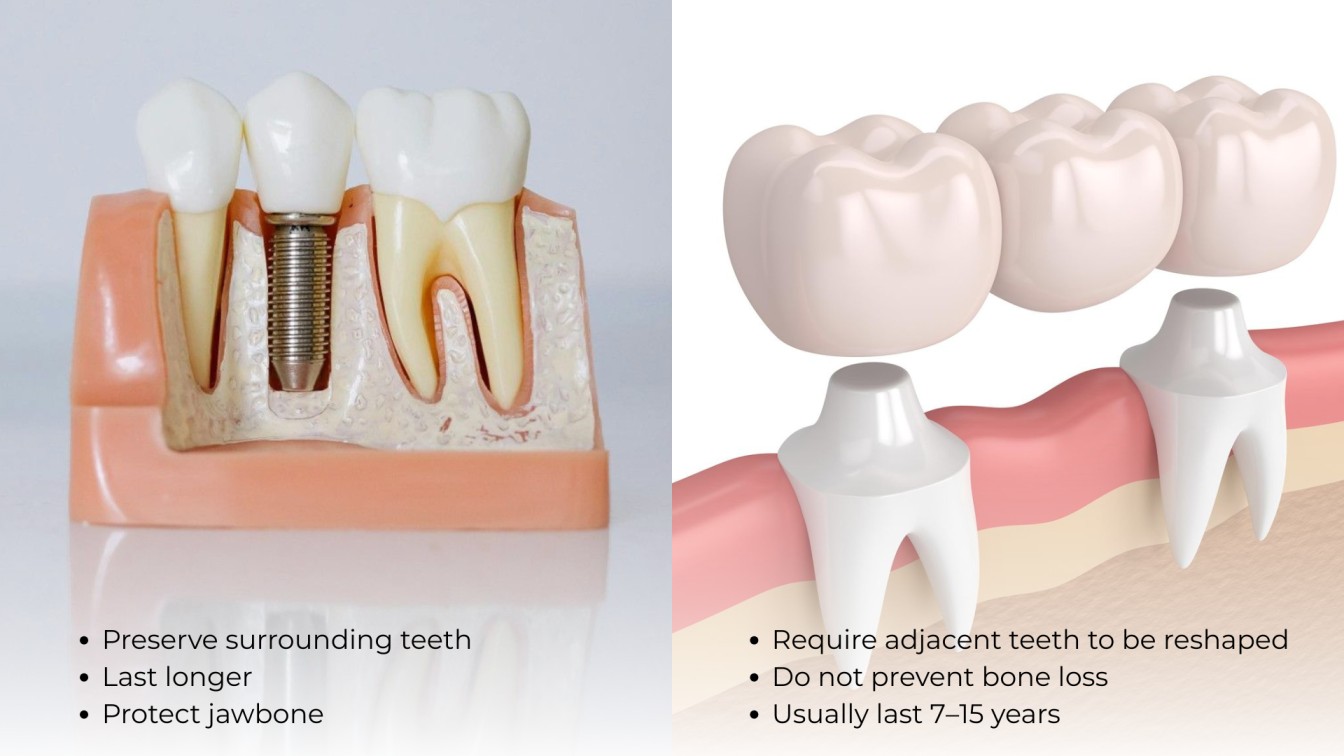
If you’re weighing implants against other options, our guide on dental bridges vs. implants walks through the trade-offs in plain language.
How the Cost of Full Mouth Dental Implants Compares
Full-mouth or full-arch implant treatment is the largest investment because it rebuilds an entire smile. Instead of replacing teeth one at a time, a small number of well-placed implants supports a complete arch. Many patients find this more comfortable and more stable than traditional dentures, and it can protect the jawbone for years to come.
Because full-mouth treatment involves more implants, more lab work, and often more planning, it costs more than single-tooth care. For some people, a combination approach — a few implants plus other restorations — is the better fit. If you’re rebuilding a whole smile, our full mouth reconstruction page explains how we plan these cases step by step. And if you’re comparing implants to a removable option, our dentures and partial dentures page can help you see the difference.
Does Insurance or the Canadian Dental Care Plan Help With the Cost?
Many private dental insurance plans cover part of implant treatment, though the amount varies a lot between plans. It’s always worth checking your annual maximum and asking whether implants, crowns, and any extra procedures are included. Some plans won’t cover the implant itself but will contribute toward the crown that sits on it — a detail that can meaningfully change your out-of-pocket cost.
The Canadian Dental Care Plan (CDCP) is a federal program for eligible residents with an adjusted family net income under $90,000 who don’t have access to private dental coverage. Depending on income, the plan pays a share of covered services, with a co-payment for many households. Coverage is limited and does not include every treatment — implants themselves generally aren’t a standard covered benefit — but related care such as exams, X-rays, and some extractions may qualify. Our Oakville team is happy to review your situation and explain what may apply before you commit to anything; you can read more on our Canadian Dental Care Plan page.
Are Dental Implants Worth the Cost?
Implants often cost more upfront than a bridge or denture, so it’s fair to ask whether they’re worth it. For many patients, they are — because a well-cared-for implant can last many years, functions much like a natural tooth, and helps protect the jawbone from shrinking after tooth loss. That long-term value is a big part of why so many people choose them.
That said, the “best” choice is the one that fits your mouth, your health, and your budget — and the only way to know is a proper exam. We’ll never push a treatment you don’t need.
Questions to Ask Before You Accept Any Implant Quote
Whichever clinic you choose, these five questions will make any estimate easier to compare:
- Does this quote include the implant, the abutment, and the crown — or just some of them?
- Is 3D imaging included, and will my case be digitally planned?
- Will I need a bone graft, sinus lift, or extraction first, and are those priced in?
- What is the plan if an implant doesn’t integrate as expected?
- How will my insurance be billed, and can the clinic help me use my benefits?
A trustworthy clinic will welcome every one of these questions and answer them in writing.
How to Get an Accurate Quote in Oakville
There’s no way to know your true cost from an online article, because your price depends on your teeth, your bone, and your goals. The right next step is a consultation. At Sol Dental Studio, that means a full exam, any imaging you need, and a clear, written estimate with your options explained — no surprises and no pressure. You can learn more about our approach on our dental implants in Oakville page.
Frequently Asked Questions
Why is there such a big range in dental implant prices?
Because “an implant” can mean anything from replacing one tooth to rebuilding a full arch. The number of implants, the type of restoration, and whether you need extra steps like a bone graft all change the total. That’s why a personalized estimate is the only accurate one.
Does the cost of a dental implant include the crown?
Not always. Some quotes list the implant post, the abutment, and the crown separately, while others bundle them. When you get your estimate, ask exactly what’s included so you can compare fairly.
Is a cheaper implant a good idea?
Be cautious. A very low price may leave out important steps like 3D imaging, quality materials, or the experience needed to avoid complications. Implants are meant to last for years, so the safest care is usually the better value over time.
Does dental insurance cover implants in Ontario?
Many plans cover part of the cost, but every plan is different. Check your annual maximum and ask whether implants and related procedures are included. Our team can help you review your coverage.
Does the Canadian Dental Care Plan cover dental implants?
Implants themselves generally aren’t a standard CDCP benefit, but eligible patients may receive help with related care such as exams, X-rays, and some extractions. Eligibility is based on income and insurance status, so it’s worth reviewing your situation with our team.
How long do dental implants last?
With good oral care and regular checkups, implants can last many years, and often much longer. Keeping up with cleanings and looking after your gums gives your implant the best chance of lasting.
Ready to Find Out What Your Implant Treatment Would Cost?
The clearest way to understand your price is a one-on-one consultation with our Oakville team. We’ll examine your smile, explain your options in plain language, and give you a written estimate you can trust.
Call Sol Dental Studio in Oakville today at (289) 644-1701 to book your dental implant consultation — or request an appointment online. We’d love to help you smile with confidence again.